
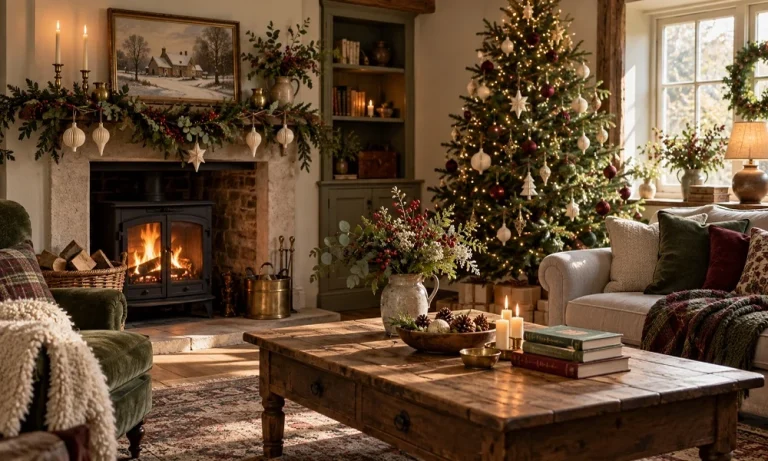
A Christmas room can feel familiar without looking exactly like last year. A painted village on a shelf, a cluster of handmade ornaments, or a botanical panel beside the tree can bring back the feeling of older celebrations while leaving room for your own taste.
For 2026, start with one scene you want to create. Perhaps it is a snowy cottage, a woodland corner, or a dresser topped with treasured decorations. Choosing that scene first makes it easier to select supplies and gives each finished piece a clear place in your home.
Find The Thread That Connects Your Decorations.
Vintage style works best when the details share something: a muted green, a soft cream background, a repeated leaf shape. They do not need to match perfectly. A little variation can help a display feel assembled over time.
The V&A’s account of Victorian Christmas traditions traces familiar customs such as cards, crackers, and decorated trees through the nineteenth century. Let that history suggest a mood rather than a strict period recreation. Pair a card-inspired illustration with ribbon, or place small ornaments beside family photographs.
Milton’s Daughter offers Iron Orchid Designs products across transfers, stamps, moulds, and paint inlays. Browse by the project you want to make, then check each product’s description, dimensions, and availability before planning a coordinated set.
A Countryside Christmas On One Shelf
Imagine a narrow shelf with a cottage scene in the middle, two small houses to one side, and a short line of evergreens behind them. Keep the tallest element off-center so the arrangement feels relaxed.
The manufacturer’s 2026 Winter Collection introduction describes countryside imagery in A Cotswold Christmas and botanical imagery in Winter’s Calling. Its village moulds and evergreen stamps offer other starting points. These are different product types, so choose the technique as carefully as the picture.
For a smaller project, suggest the village with a single decorated panel. Stand it behind a plain wooden house and a bowl of ornaments. A restrained background lets the scene remain readable from across the room, especially when the shelf also holds everyday objects.
Give The Tree A Handmade Focal Point.
Instead of remaking every ornament, create a small group with one shared detail. Cream backgrounds, aged gold accents, and narrow burgundy ribbon can tie together several different shapes.
Lay the blanks on a table before decorating. Decide which will carry a detailed image and which will remain simple. A busy motif needs space around it; a smaller branch or bird can sit comfortably on a modest shape. Make one sample before committing to the entire group.
Use the sample to check proportion and finish. Hold it at the distance from which you will see the tree. If the illustration disappears, simplify the surrounding decoration rather than adding more detail. Follow the chosen product’s instructions for the blank, adhesive, finish, and drying time.
Turn A Quiet Corner Into A Winter Botanical Display.
Not every seasonal piece needs Santa or a Christmas greeting. Branches, birds, and woodland imagery can suit a room through the colder months.
Try a decorative panel above a small chest, with one ceramic vase and a folded wool throw nearby. Repeat a color from the artwork in the textile. Keep the other surfaces fairly plain so the illustration has room to stand out.
For a darker room, consider a pale background that separates the motif from surrounding wood. In a bright room, a deeper green or brown could provide contrast. Test the combination on a spare board before painting the finished piece; screen images cannot show exactly how your room’s light will affect a color.
Make The Gift Feel Considered.
A handmade gift becomes more useful when its scale suits the recipient. A small decorative plaque may fit someone with limited shelf space better than a large centerpiece. A winter botanical design may also suit someone who prefers decorations to stay out after December.
Choose the object first, then the embellishment. Leave enough uninterrupted space for the shape and material to remain visible. Include a simple care note based on the products used, and allow the finish to cure before wrapping. Avoid presenting an embellished surface as food-safe unless its materials are specifically approved for that use.
Choose One Project To Begin.
Pick the shelf scene, ornament group, or botanical panel that you can picture most clearly in your home. Check its dimensions, make a sample, and gradually build the surrounding display. Explore Milton’s Daughter’s collection to choose the supplies for your first vintage Christmas project.