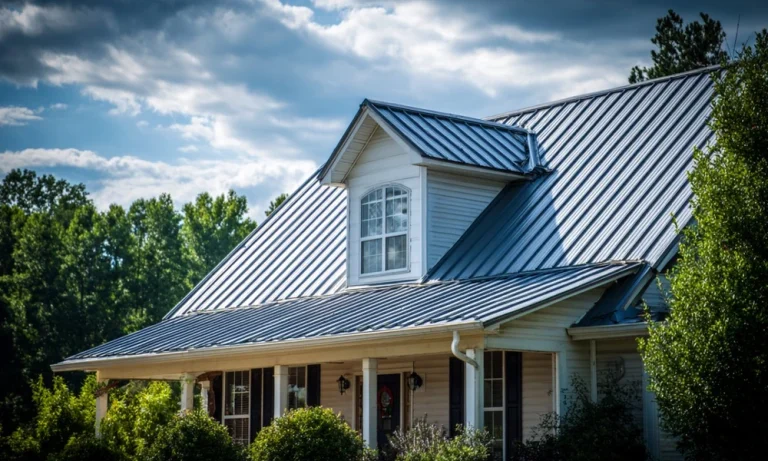
A roof installed this year could still be protecting its building in the 2050s. That sounds obvious, but it raises a question that is surprisingly easy to overlook.
What sort of weather should that roof be designed for?
Traditionally, roofing decisions have been heavily influenced by what has worked before. Materials have established track records, drainage calculations are based on recognised standards and contractors know which systems perform reliably in British conditions.
The difficulty is that those conditions are changing.
Roofs being replaced today will experience decades of weather that may look increasingly different from the climate in which the buildings beneath them were constructed. Hotter summers, periods of drought, intense rainfall and changing expectations around energy efficiency are altering what we ask a roof to do.
For property owners planning substantial roofing work, thinking about 2050 rather than simply solving today’s problem could prove one of the most important decisions they make.
A roof is a long-term investment
Few building components are replaced casually.
A properly specified and installed roof should provide many years of service, which means decisions made during refurbishment or replacement have consequences extending far beyond the immediate project.
This is particularly relevant across Surrey and the South East, where the building stock varies enormously.
A Victorian terrace in Guildford has different requirements from a modern detached house outside Woking. A large commercial unit near the M25 faces different challenges again.
Yet they have something in common.
Work carried out now needs to perform through the 2030s, 2040s and potentially well beyond.
Simply recreating what was there before may not always be the best answer.
Britain’s weather is becoming harder to design around
The challenge is not simply that Britain is becoming warmer.
Buildings increasingly need to cope with extremes.
Long periods of dry, hot weather can be followed by sudden heavy rainfall. Roof surfaces experience high temperatures before cooling considerably overnight. Drainage systems can sit almost unused for weeks before being expected to handle a substantial volume of water in a short period.
The roofing industry is already paying greater attention to climate resilience for precisely this reason.
A roof that performs well in average conditions still needs to cope with the days that are anything but average.
For homeowners, this does not mean attempting to predict exactly what Surrey’s weather will be on a particular Tuesday in August 2048. It means allowing sensible margins for the conditions a building is likely to experience throughout the roof’s working life.
Drainage deserves more attention than it gets
Waterproofing tends to receive most of the attention when people discuss roofing.
Drainage is just as important.
A roof can have an excellent waterproof covering and still experience problems if rainwater cannot escape efficiently.
Gutters, valleys, outlets and downpipes all form part of the same system. If one component cannot cope, water will find somewhere else to go.
This becomes increasingly important when rainfall arrives intensely rather than gradually.
A short period of extremely heavy rain can place far greater pressure on roof drainage than several hours of lighter rainfall, even if the total amount of water is similar.
When substantial roofing work is being planned, it therefore makes sense to consider how the entire roof manages water rather than concentrating exclusively on the covering itself.
Overheating is becoming a roofing issue
For generations, the British conversation about roofs has largely focused on keeping buildings warm and dry.
Keeping them cool is becoming increasingly relevant.
Roofs receive significant solar exposure, and the way they are designed can influence temperatures within the building below.
Insulation, ventilation, roof colour, construction method and the materials used all play a part.
The solution is not simply to add as much insulation as possible.
A poorly considered combination of insulation and ventilation can create new problems, particularly where moisture movement through the building has not been properly understood.
Older properties deserve particular care. Buildings designed to behave in one way can react badly when modern materials are introduced without considering how the original structure manages heat and moisture.
Future-proofing is therefore about understanding the building as a complete system rather than selecting individual products because they have impressive specifications.
Solar is changing what we expect from roofs
Until relatively recently, the primary job of most domestic roofs was straightforward: keep the weather outside.
That job description is expanding.
Increasing numbers of roofs are being used to generate electricity, and a homeowner replacing a roof today may reasonably expect solar panels to be installed during its lifespan even if they are not part of the immediate project.
That creates several practical considerations.
Is the roof covering likely to remain serviceable for the expected life of the solar installation?
Will future access be straightforward?
Where will panels and fixings be positioned?
Would completing necessary roofing work before installing solar avoid having to remove the panels again several years later?
These questions are considerably easier to address during a planned roofing project than after an installation has already taken place.
A cheap solution today can become expensive if substantial sections have to be dismantled later.
Flat roofs are becoming working spaces
The evolution is even more noticeable on commercial buildings.
A large flat roof may now accommodate solar panels, air-conditioning equipment, ventilation systems and other building services. Some developments incorporate green roofing or measures designed to manage rainfall more effectively.
The roof is no longer simply the lid on the building.
It is valuable usable space.
That places greater demands on waterproofing, access, detailing and maintenance.
Anyone responsible for a large building needs to consider not only what will be installed when the roof is constructed, but what might be added ten or twenty years later.
Good commercial roofing design leaves room for the building to evolve rather than making every future alteration unnecessarily complicated.
Material choice needs to look beyond the installation date
Price understandably influences any roofing project.
It should not be the only measure of value.
A system that costs less initially but requires significantly more intervention over its lifespan may prove considerably more expensive in the long run.
Durability matters, but so do repairability and maintenance.
Can isolated areas be repaired if damaged?
Can the roof accommodate later alterations?
How easy is it to inspect?
What happens when additional equipment needs to pass through the covering?
Modern single-ply systems such as Alwitra Evalon roofing are one example of how roofing technology has developed to meet increasingly complicated requirements, particularly on flat and low-pitched roofs.
The important point is not that one material is automatically right for every project. It is that specification should reflect how the building will actually be used over the coming decades.
Maintenance should be designed in from the beginning
One of the least glamorous questions during a roofing project is also one of the most useful.
How will somebody maintain this in fifteen years?
A beautifully finished roof can become unnecessarily difficult to manage if outlets are hard to access, plant equipment prevents inspection or vulnerable junctions cannot easily be reached.
Commercial buildings have long had to think about safe roof access because maintenance teams regularly need to inspect equipment.
Domestic properties can benefit from the same principle on a smaller scale.
A roof that can be inspected and maintained easily is more likely to remain in good condition.
That sounds simple, but maintainability is often considered only after something goes wrong.
Future-proofing does not mean overengineering everything
There is a danger in discussions about climate resilience of making every project sound enormously complicated.
It does not need to be.
A typical house does not suddenly require the specification of an airport terminal because summers are getting warmer.
Future-proofing is about making proportionate decisions.
It might mean improving ventilation while the roof is open.
It could mean reviewing whether existing gutters and outlets are adequate.
It may involve replacing ageing leadwork rather than reusing something likely to fail long before the new roof covering.
On another property, it could mean considering future solar installation before deciding how the roof should be rebuilt.
Often, the difference between a roof designed only for today and one designed for the future is simply asking better questions at the beginning.
The cheapest time to solve tomorrow’s problem is often today
Roof replacement provides a rare opportunity.
Materials are removed, areas that have been hidden for decades become accessible and the underlying structure can be properly inspected.
Once everything has been covered again, making substantial changes becomes more difficult and expensive.
That is why a roofing project should not simply reproduce the roof that came before it.
The existing design may still be perfectly appropriate. In many cases it will be. But it deserves to be questioned rather than automatically copied.
What will this building need in twenty years?
Could solar be installed?
Will summers become harder to manage?
Can drainage cope with intense rainfall?
Is maintenance straightforward?
Are the chosen materials appropriate for the expected lifespan of the building?
None of those questions requires anyone to know exactly what the climate of 2050 will look like.
They simply recognise an unavoidable fact about roofing.
A roof installed in 2026 is not really being built for 2026. It is being built for every winter storm, summer heatwave and sudden downpour that property will experience for decades afterwards.
The best time to prepare it for those conditions is before the first tile, sheet or membrane goes down.