
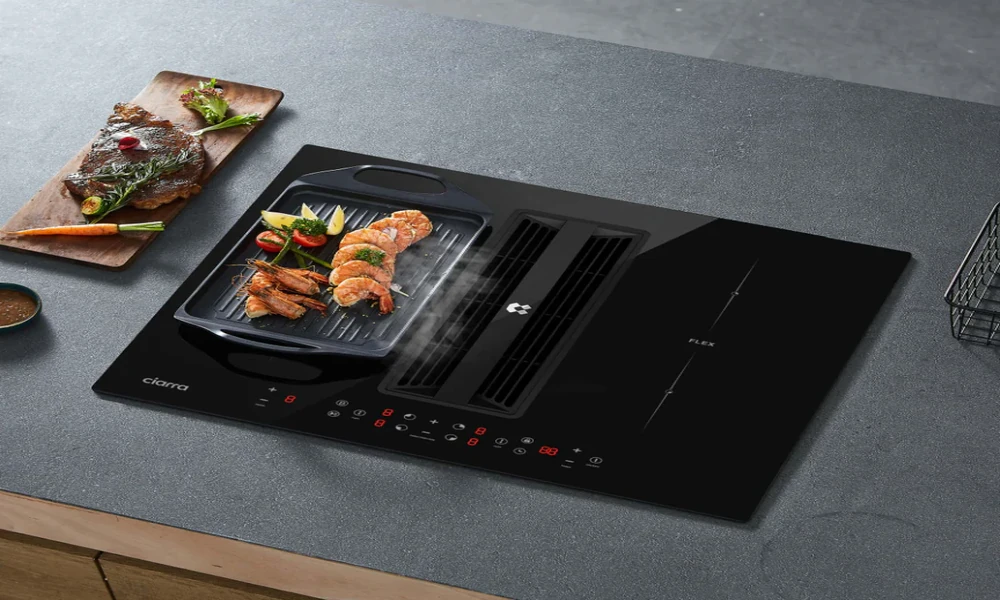
The combination of an induction hob and extraction system in a single unit represents one of the most significant practical innovations in kitchen appliances in recent years. By integrating ventilation directly into the cooking surface, these units eliminate the need for a separate overhead hood, opening up cabinetry above the hob, improving sightlines in open-plan spaces, and simplifying the kitchen design without compromising extraction performance.
How Integrated Extraction Works
Integrated extractor hobs draw cooking vapours downward through the hob surface itself, rather than upward into an overhead hood. Slots or grilles positioned between the cooking zones capture steam, grease, and odours at their source – close to the pan – before channelling the air through filters and either recirculating it or exhausting it externally via an underfloor or worktop-level duct route.
Advantages Over Traditional Overhead Hoods
The best induction hob with integrated extractor installations offer several meaningful advantages for specific kitchen configurations. In island installations, eliminating the overhead hood removes a structural element that can interrupt the visual flow of a kitchen and limit sight lines between cooking and living areas. For lower-ceilinged spaces, the absence of an overhead hood creates a less cluttered, more open atmosphere.
Performance Considerations
Integrated extraction captures vapours before they rise, which is theoretically more efficient than overhead capture. However, effective performance depends heavily on extraction power and filter quality. For high-intensity cooking, ensure the unit’s extraction rating is adequate for your typical cooking style. Some integrated models also offer boost modes for more demanding cooking tasks.Leading appliance brands like Ciarra One have developed integrated hob-extractor combinations with extraction specifications designed to handle the full range of domestic cooking demands.
Installation Requirements
Integrated extractor hobs require careful planning for the air routing. In worktop installations, ducting typically runs below the worktop surface and out through a cabinet. In island installations, ducting is usually routed through the floor. Both approaches require advance planning during the kitchen design phase – retrofitting an integrated extractor into an existing kitchen is considerably more complex than installing one during a renovation.
Maintenance
Grease filters in integrated extractors require regular cleaning – typically more frequently than overhead hood filters because of their proximity to the cooking surface. Most models use dishwasher-safe filter elements to simplify maintenance. Carbon filters for recirculating models need periodic replacement following the manufacturer’s schedule.

Comments are closed.